
24/7
operational environment
05B
Q-Mark fire stopping
052
Q-Mark installation
0
operational disruption
The challenge
An airport terminal is the hardest environment in the country in which to carry out passive fire protection work, and not because of the work itself. It is because of everything around it.
Access is controlled. Every operative needs an airside pass, which means referencing, criminal record checking and airside driving or escort arrangements before anyone lifts a tool. Every task needs a permit, and the permit defines where you may be, when, and what you may do — hot works in particular are tightly controlled.
The building never closes. Work in public-facing areas happens overnight and has to be fully reinstated, cleaned and signed off before the terminal fills again. Work in back-of-house areas, risers and plant rooms competes with the airport's own maintenance programme for the same shutdown windows.
And the fire strategy is unforgiving. Compartment lines in a terminal separate escape routes, baggage handling and plant from public concourse. A penetration left unsealed after a cable pull is not a paperwork problem — it is a hole in a compartment wall in a building that may hold tens of thousands of people.
What we did
We work at Heathrow under full permit control with security-cleared operatives, planning each visit around the permit rather than the other way round. Scopes are broken into shift-sized packages that can be started, completed and reinstated inside a single overnight window, so no area is ever left part-finished when the terminal opens.
Fire stopping is installed under our BM TRADA Q-Mark 05B certification to the tested system for the substrate and service in front of us — not a generic seal. Service penetrations, linear joints, cavity barriers and blank openings are each treated as a separate assessed detail, with the correct product, depth and annular gap for that tested configuration.
Every seal is photographed before closing, labelled, and recorded against its location on the drawing in Onetrace. On a site where nobody can go back and open a wall to see what is behind it, the photograph taken at the moment of installation is the only evidence that will ever exist.
Fire door works follow the same discipline under schemes 052 and 058: certified doorsets installed to the manufacturer's tested details, or existing doorsets repaired where the scheme allows the repair, each one labelled and registered.
The outcome
The airport gets compartmentation work that will stand up to audit, delivered without a single disruption to operations, and a record of every asset that its own teams and future contractors can read.
For Arctic Fire it is the clearest demonstration of what our certification is actually for. Anyone can claim they seal penetrations. Doing it under airside permit control, overnight, with an auditable evidence trail behind every one is a different proposition — and it is why the same disciplines now apply on every job we take, whether it is a whole terminal or a single doorset in a back corridor.
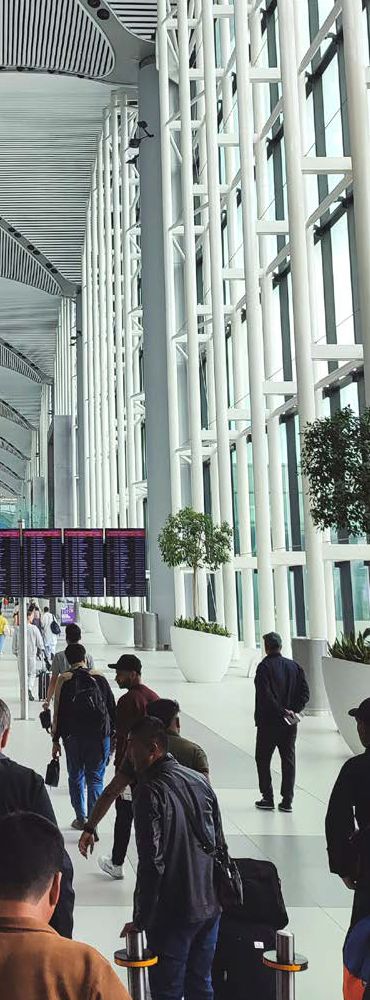
Illustrative — airside photography is restricted. Project images subject to client permission.
Related
Need the same evidence for your estate?
Tell us the building and roughly how many doorsets or penetrations are in it and we will come back with a fixed price. Call 020 8769 8869 or send the details over.