
05B
certified fire stopping
Extract
grease duct penetrations
Before
ceilings close
Per unit
handover evidence pack
This project is written up without naming the client. The work, the standards and the approach are exactly as described; the building and the operator are not identified.
The challenge
Quick-service restaurant brands open units one at a time, and each unit is fitted out against a trading date that has already been announced. Landlord possession, strip-out, M&E, kitchen install, snagging and handover are compressed into a few weeks, and the programme has no slack in it.
Each unit also sits inside somebody else's building, with its own fire strategy and its own compartment lines. The fit-out drives extract ducts, gas, power, data and drainage through those lines. The licence to alter almost always requires the operator to evidence that it was done properly — and the lease makes the operator, not the fit-out contractor, the one holding that obligation afterwards.
Kitchen extract is the specific problem. A grease extract duct crossing a compartment wall is a demanding penetration: large, hot, requiring cleaning access, and needing a detail tested for that exact configuration. It is also the penetration most likely to be cut in late by a specialist contractor who has demobilised before anyone asks about the seal.
For a brand with more than one unit, the compounding issue is consistency: different fit-out contractors, different landlords, and no easy way to show the same standard was applied in each.
What we did
We deliver the fire stopping as a named package on the unit rather than leaving it to whichever trade is last out. The scope covers the penetration types that recur in every restaurant build: extract, gas, power, data, drainage, and blank openings left for future capacity.
We work to the trading date and mobilise at short notice, sealing before the ceilings and bulkheads close. That timing is not a convenience — it is the only point at which the evidence photograph can be taken. Once the finishes are on, nobody can see what is behind them, and no amount of paperwork afterwards can prove what was installed.
Kitchen extract penetrations are sealed to the tested detail for that duct, substrate and aperture, with cleaning access preserved. Where the duct route or the wall build-up falls outside the tested scope of the obvious system, we say so and specify one that covers it rather than installing the nearest thing to hand.
All fire stopping is installed under our BM TRADA Q-Mark scheme 05B certification. Every penetration is photographed, labelled and recorded against its location, and the unit closes out with an evidence pack in a consistent format — so the next unit's record reads like the last.
The outcome
The operator holds a photographed record for the unit, in a format they can hand straight to a landlord at handover, to an insurer, or to a local authority inspector. That removes the most common failure in fit-out fire safety, which is not bad workmanship but missing evidence.
It also removes the argument. When the fire stopping is a named package with a certified contractor attached, it stops being the gap between the M&E contractor and the main contractor that nobody priced.
For a brand opening more than one unit, the benefit compounds: the same standard, demonstrably applied, wherever the unit is and whoever fitted it out.
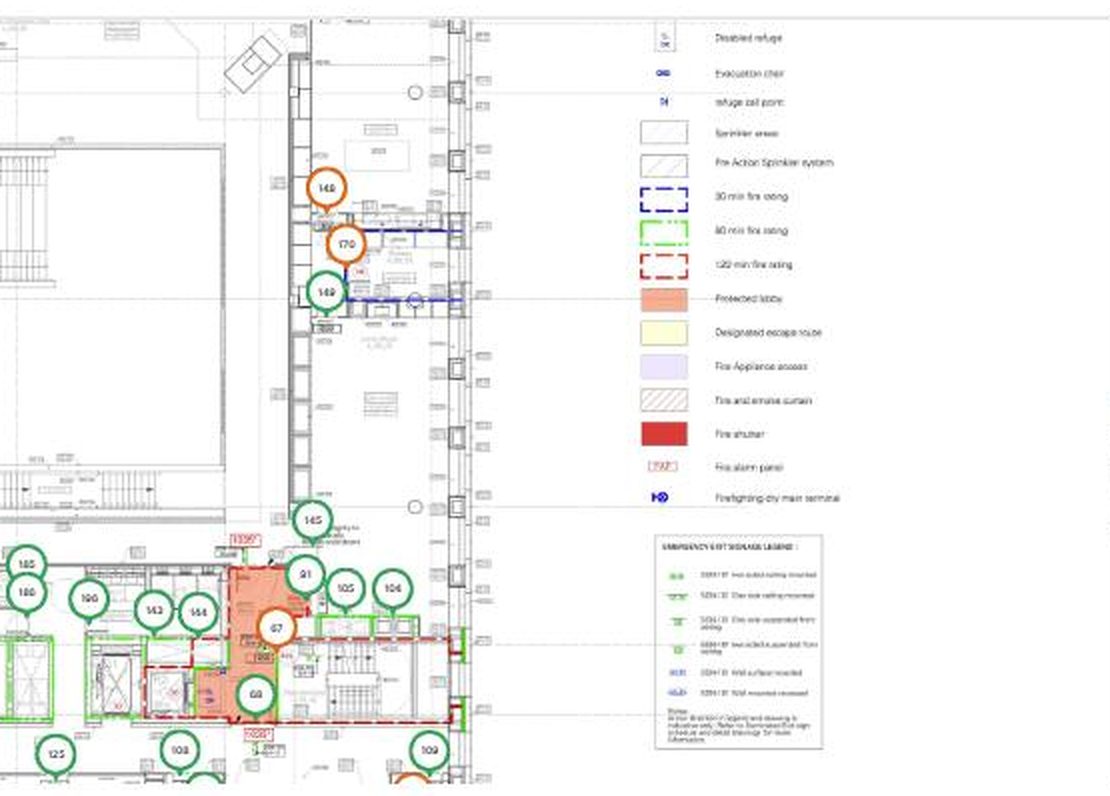
Each penetration recorded at its location — the pin opens the photographed asset record.
Related
Need the same evidence for your estate?
Tell us the building and roughly how many doorsets or penetrations are in it and we will come back with a fixed price. Call 020 8769 8869 or send the details over.