
Since January 2023, the Responsible Person for a multi-occupied residential building with storeys over 11 metres must carry out quarterly checks of fire doors in communal areas and annual checks of flat entrance doors, on a best-endeavours basis, and keep a record. Below 11 metres, the duty to provide residents with information about fire doors still applies — and the general duty under the Fire Safety Order applies to every block regardless of height.
For a housing provider with a stock of blocks, that is not a fire door problem. It is a programme management problem with a fire door in it. The hard part is not checking a door; it is knowing how many doors you have, where they are, which ones you checked in which quarter, and being able to prove it two years later when somebody asks.
Alongside the doors sits the compartmentation itself — and in low-rise terraced and converted stock, the single most common and most serious defect is in the roof void, where the party wall was never taken up to the underside of the roof covering.
The regulations that bite in this sector
- Fire Safety (England) Regulations 2022, Regulation 10 — quarterly communal and annual flat entrance door checks in buildings over 11 metres.
- Regulation 5 — information to residents about fire doors, applying to all multi-occupied residential buildings.
- Fire Safety Act 2021 — confirming that structure, external walls and flat entrance doors fall within the fire risk assessment.
- Regulatory Reform (Fire Safety) Order 2005 — the underlying duty on the Responsible Person.
- Building Safety Act 2022 — Golden Thread and, for higher-risk buildings, the safety case.
What we typically find
- Flat entrance doors replaced by residents with unrated doors, or original doorsets with the intumescent seals painted solid.
- Communal doorsets propped, wedged or with closers disconnected because they are too heavy for residents.
- Party walls stopping at ceiling level in the roof void — the single most common serious defect in terraced and converted stock.
- Services run through compartment walls during rewires, boiler replacements and broadband installs, never sealed.
- Riser and meter cupboard doors with no rating and no self-closing.
- No asset list at all — the provider does not know how many doorsets are in the block.
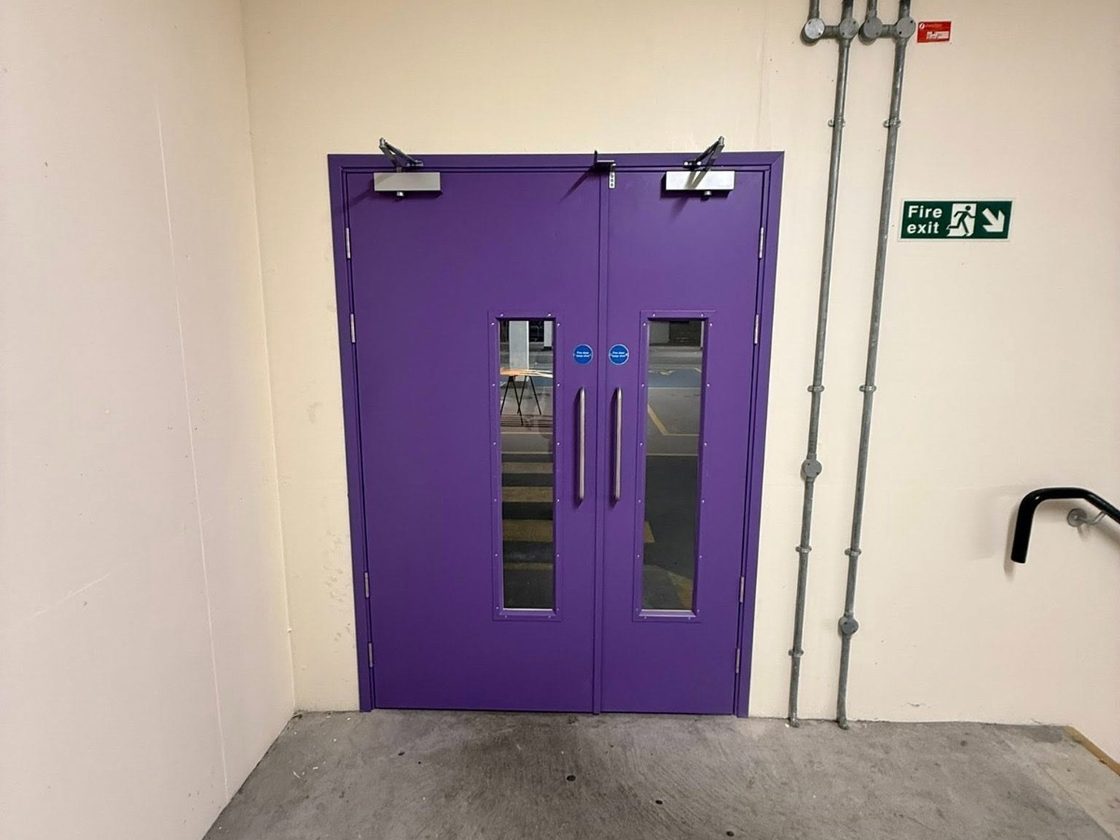
Illustrative — our own project photography is being added as we collect it.
Working inside the constraints
Programme, not one-offs — We survey the stock, build the register, then run the quarterly and annual checks against it so the record is continuous and dated rather than a series of disconnected visits.
Resident liaison — Appointment-based access for flat entrance doors, with letters and arrangements agreed before we arrive. Failed access is recorded and re-offered, which is what best endeavours actually means.
Repair where the scheme allows — Under Q-Mark 058, a flat entrance door with damaged seals or failed ironmongery can very often be brought back to compliance rather than replaced — materially cheaper across a stock, and far less disruptive for the resident.
A register that proves it — Every door and every seal QR-tagged in Onetrace with a dated history, so a Regulation 10 record is produced by doing the work rather than typed up afterwards.
Related work
Costed, banded remedial programmes and continuous Regulation 10 records — written so a small team can act on them without a consultant to interpret them.
From enquiry to certification
Enquiry
Tell us about the building and the works you need.
Site survey
Every asset inspected, photographed and QR-tagged.
Specification
Clear scope and pricing against tested systems.
Certified works
Competency-assessed operatives under scheme control.
Evidence pack
Photos, registers and product data for every asset.
Certification
Q-Mark labelled, registered and traceable for life.
Tell us about the building.
A short conversation is usually enough for us to tell you what a survey or a package of works looks like and what it costs. Call 020 8769 8869.
Tell us about the site
Send us the details and anything you already have — drawings, an old survey or photos. We will be in touch within one working day.
- BM TRADA Q-Mark certified, certificate 4515
- Named Approved Persons accountable for the work
- Every asset photographed and recorded
Prefer to talk? Call 020 8769 8869 (Mon–Fri 07:30–17:30) or email fire@arcticltd.com.