Healthcare buildings evacuate differently from everything else. Most occupants cannot self-evacuate; many cannot be moved at all without clinical risk. The strategy is therefore progressive horizontal evacuation — moving people sideways into an adjoining compartment and holding them there — which puts the entire weight of life safety onto the compartment walls, the doors in them and the seals through them.
That makes a breached compartment line in a hospital a categorically different problem from a breached compartment line in an office. In an office it shortens the time available to get out. In a ward it removes the place people were going to be moved to.
Healthcare estates are also relentlessly modified. Medical gas lines, data, nurse call, new imaging equipment, ventilation upgrades — every one of them puts new services through walls that were sealed correctly the day they were built. The compartmentation degrades continuously unless somebody is actively maintaining it.
The regulations that bite in this sector
- Regulatory Reform (Fire Safety) Order 2005 — the Responsible Person's duty to ensure adequate general fire precautions.
- Health Technical Memorandum HTM 05-02 — fire safety in the design of healthcare premises, including compartmentation and progressive horizontal evacuation.
- HTM 05-03 Part K and the wider HTM 05 suite — operational fire safety management in healthcare premises.
- Building Safety Act 2022 — the expectation that the estate can produce current, accurate information about its fire safety measures.
- BS 8214 for fire doorset installation and maintenance; BS EN 1366 for the tested performance of service penetration seals.
What we typically find
- Medical gas and data runs pushed through existing seals without reinstatement.
- Ward doors held open on wedges or by equipment because the closer is over-tensioned for staff pushing beds through.
- Damaged leaves and lippings from trolley and bed impact, well beyond cosmetic.
- Compartment walls above ceilings breached by successive ventilation and cabling projects.
- Fire dampers in ward and theatre ventilation that have never been accessed, let alone tested.
- Doorsets with the correct rating but ironmongery that has been swapped for an uncertified equivalent.
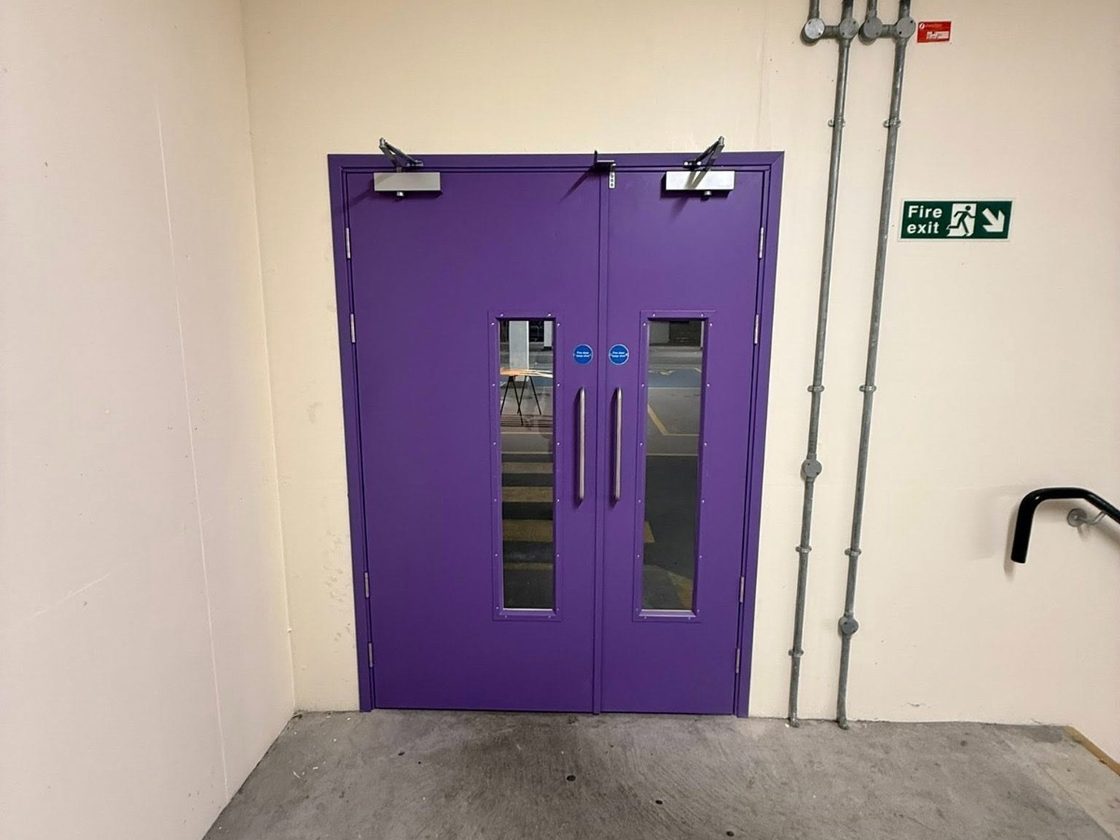
Illustrative — our own project photography is being added as we collect it.
Working inside the constraints
Clinical constraint first — Works are planned around ward availability, theatre lists and decant options — and if the estate cannot give us the space, we phase it down to individual doorsets rather than demanding a closure.
Infection control — Dust suppression, screening and cleaning regimes agreed with the infection prevention team before mobilisation, not negotiated on site.
Repair before replace — Under Q-Mark scheme 058 a damaged ward doorset can very often be brought back to a compliant condition in a single visit — which in a live ward matters more than the cost saving.
Evidence per asset — Photographed, dated records for every doorset and every seal, held in a register the estates team can search — because in healthcare the audit will come.
Related work
Our experience in buildings that cannot stop for the work comes largely from aviation and live public venues — the disciplines translate directly.
From enquiry to certification
Enquiry
Tell us about the building and the works you need.
Site survey
Every asset inspected, photographed and QR-tagged.
Specification
Clear scope and pricing against tested systems.
Certified works
Competency-assessed operatives under scheme control.
Evidence pack
Photos, registers and product data for every asset.
Certification
Q-Mark labelled, registered and traceable for life.
Tell us about the building.
A short conversation is usually enough for us to tell you what a survey or a package of works looks like and what it costs. Call 020 8769 8869.
Tell us about the site
Send us the details and anything you already have — drawings, an old survey or photos. We will be in touch within one working day.
- BM TRADA Q-Mark certified, certificate 4515
- Named Approved Persons accountable for the work
- Every asset photographed and recorded
Prefer to talk? Call 020 8769 8869 (Mon–Fri 07:30–17:30) or email fire@arcticltd.com.